Start here: what to know before you use a peptide
In short
About 9 minutes for the short version; 14 with every detail open.
- Many peptides sold outside pharmacies were never tested well in people. Their effects and risks are not known.
- A product that did not come from a pharmacy has not been checked by a regulator.
- In the Netherlands, selling a medicine that has no licence is against the law.
- A few peptide medicines, such as semaglutide, are well tested. A doctor can prescribe them.
- If you decide to use one, learn the warning signs. Get help fast if something feels wrong.


Each section starts with the short answer. The rest is folded under “In detail”.
Who is this page for?
This page does not tell you what to do. It gives you six things to know, in the order you need them. It gives no doses and names no sellers. Every fact links to its source, so you can check it.
1. Most have never been tested properly in people
Have these peptides been tested in people?
| Semaglutide (an approved medicine) | BPC-157, TB-500 and KPV (experimental) | |
|---|---|---|
| Tested in large, fair trials in people? | Yes One weight trial alone had 1,961 adults.1 | No No study of KPV, or of TB-500 alone, in people is published. BPC-157 had two small trials, known only from short conference abstracts.2,3,4 |
| Side effects counted, with how often they happen? | Yes They are on the official label, with how often each one happens.5 | No No proper study has counted them.4,3,2 |
| Safety followed over years? | Yes One trial followed 17,604 adults for more than three years on average.6 | No The formal safety tests of BPC-157 with daily doses, in rats and dogs, lasted 28 days.7,4 |
| Benefits and risks weighed by a regulator? | Yes Before it was approved in the EU.5 | No None of them is an approved medicine.4,3,2,8 |
“Never tested properly” does not mean “certain to harm you”. It means nobody knows. Nobody knows if it works in people. Nobody knows which side effects it causes, or how often. Nobody knows what months of use do. Most research on these three peptides was done in cells, rats and mice, not in people.4,3,2
In detail: Why animal results are not enough , about 2 minutes to read
A result in rats is a reason to test something in people. It is not proof that it works in people. Lab results also often fail when other scientists repeat them. Scientists at one company could confirm only 6 of 53 key cancer studies.9,10 See the translation gap.
Even after trials in people have started, most attempts to bring a medicine to patients fail. A study counted each medicine for one illness as one attempt. Only about 1 in 7 of these attempts ended in approval.11
Most attempts that reach trials in people never lead to an approved medicine
13.8%
of drug programmes that started human trials were approved in the end: about 1 in 7
What was counted 41,040 industry drug programmes (one drug for one illness) with trials from 2000 to 2015 (Wong 2019) Source Wong et al. (2019)11
For KPV, the FDA found no study in people at all. For TB-500 it found no human data. Two small reports gave people TB-500, or a related “TB4”, only together with other substances.2,3,12,13
BPC-157 has been studied in people a little. In the 2000s, two small controlled trials tested it as an enema. One was in 32 healthy men, one in 53 people with bowel inflammation (ulcerative colitis). The results exist only as conference abstracts: short summaries for a meeting.4 Four small reports on 33 people in total were published later. None had a comparison group. In two of them, some or all people also got other substances.13,14,15,12 See BPC-157, TB-500 and KPV.
2. The vial is not the molecule
Is a vial from outside a pharmacy the same as the medicine?
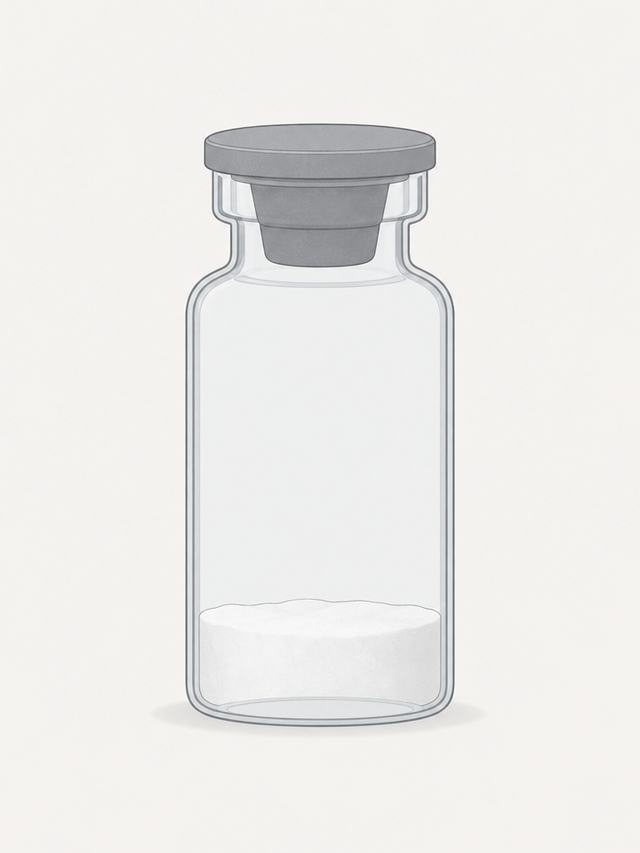
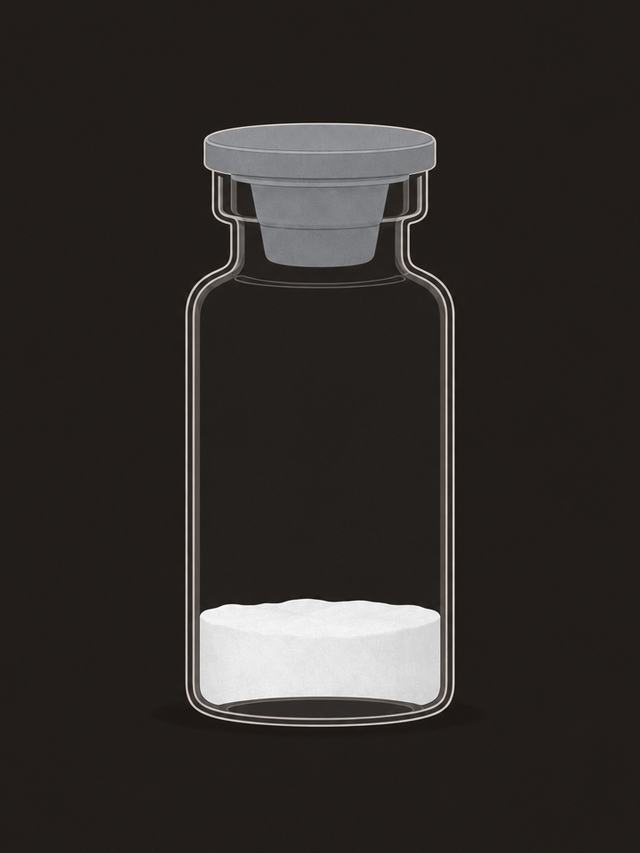
The picture shows what may be wrong with a vial that did not come from a pharmacy.
Key
- Marker 1: May not be what the label says The FDA warns that one name can cover different salt forms, or even a different active substance. A French lab found that products sold as TB-500 did not always match their description.
- Marker 2: The amount may differ from the label A 2026 study in Australia tested 3 products sold as retatrutide. They held from about half to almost twice the amount on the label. The TB-500 certificates the FDA saw did not check the amount.
- Marker 3: May hold near-copies and leftover chemicals Making a peptide can leave chains that are too short or slightly wrong, plus leftover solvents and other chemicals. Most certificates the FDA saw gave the purity but did not say which impurities were there.
- Marker 4: May not be tested for bacterial toxins (endotoxin) For anything injected, the FDA says this test is key. The certificates it saw for BPC-157 and TB-500 did not have it.
- Marker 5: May not be tested for germs For injections, the FDA says germ tests are key too. The certificates it saw for BPC-157, KPV and TB-500 showed no germ tests.
- Marker 6: Clumps may make immune reactions more likely Peptides can stick together into clumps. The FDA says clumps and impurities may raise the risk of an immune reaction, from harmless to life-threatening. No study has tested this for BPC-157, KPV or TB-500.
In words
The picture shows one small glass vial with a grey rubber stopper and some white powder at the bottom. It has no label. Six numbers show what may be wrong with a vial like this when it is bought online. Number 1, on the glass where a label would be: it may not be what the label says. The FDA warns that one name can cover different salt forms, or even a different active substance. A French lab found that products sold as TB-500 did not always match their description. Number 2, on the powder: the amount may differ from the label. A 2026 study in Australia tested 3 products sold as retatrutide. They held from about half to almost twice the amount on the label. The TB-500 certificates the FDA saw did not check the amount. Number 3, on the powder: making a peptide can leave chains that are too short or slightly wrong, plus leftover solvents and other chemicals. Most certificates the FDA saw gave the purity but did not say which impurities were there. Number 4, inside the vial: it may not have been tested for bacterial toxins, called endotoxin. For anything injected, the FDA says this test is key, and the certificates it saw for BPC-157 and TB-500 did not have it. Number 5, inside the vial: it may not have been tested for germs. For injections the FDA says germ tests are key too, and the certificates it saw for BPC-157, KPV and TB-500 showed no germ tests. Number 6, on the powder: peptides can stick together into clumps. The FDA says clumps and impurities may raise the risk of an immune reaction, from harmless to life-threatening. No study has tested this for BPC-157, KPV or TB-500. That is why number 6 has a different colour: it is a possible risk, not a proven one.
Based on: FDA Briefing Document for BPC-157-Related Bulk Drug Substances (BPC-157 (free base) and BPC-157 acetate), Pharmacy Compounding Advisory Committee meeting, 23–24 July 2026; FDA Briefing Document for KPV-Related Bulk Drug Substances (KPV (free base) and KPV acetate), Pharmacy Compounding Advisory Committee meeting, 23-24 July 2026; FDA Briefing Document for TB-500-Related Bulk Drug Substances (TB-500 (free base) and TB-500 acetate), Pharmacy Compounding Advisory Committee meeting, 23–24 July 2026; Piatkowski et al. (2026); Delcourt et al. (2023)
AI-generated illustration (gpt-image-2.5-sunburst-2026-09-08, 21 October 2026) CC BY 4.0 Image details The picture contains no text; the numbers and labels are added by this site.
This is true even when the name is right. Semaglutide is an approved medicine. But “research semaglutide” sold online is not that medicine: no regulator has checked it.16,17 Clean technique cannot fix what is inside a vial. See product risk.
In detail: What can be wrong, with real examples , about 1 minute to read
- The wrong amount. In 2026, researchers in Australia tested three products sold as retatrutide. They held from about half to almost twice the amount on the label.18
- The wrong substance. In 2023, fake pens sold as Ozempic in Germany held insulin, not semaglutide.19 Insulin can make blood sugar fall too low.20 Someone who thinks they are injecting semaglutide does not expect that.
- Germs before the vial is opened. In the United States in 2012, injections made by one pharmacy were contaminated with a fungus. Fungus was found in vials that had never been opened. By July 2013, 749 people were ill and 61 had died.21 Careful technique by the people who gave the injections could not have prevented it.
The Dutch health inspectorate (IGJ) says that a medicine ordered online can hold too much active substance, too little, or none. If it is contaminated, it can damage your organs.22
In detail: What you can check yourself, and what you cannot , about 1 minute to read
You can read the label and any paper that came with the product. You cannot see what is inside the vial, or how much of it. Without the checks that come with a doctor or pharmacist, you cannot know what you are getting.22
- Is there a lab certificate? It is often called a certificate of analysis. It lists the tests a lab did, and their results.4
- Does it test for germs and bacterial toxins? For anything injected, the FDA calls three tests key: no germs (sterility), no bacterial toxins (endotoxin) and no loose particles.4,3
- Does it give more than purity? Purity alone does not say which impurities are there, or how much peptide is in the vial.4,3
- Does the name match exactly? One name can cover different salt forms, or even a different substance.3
The FDA looked at certificates for BPC-157, TB-500 and KPV. Most of the ones it found gave little more than a purity result. None showed a test for germs.4,3,2 Our page on product risk goes further.
3. The law in plain words
Is it legal?
| An approved peptide medicine (for example Wegovy) | An unapproved peptide (for example BPC-157) | |
|---|---|---|
| Licensed to be sold as a medicine? | Yes Approved in the EU since 2022.5 | No Not approved in the EU or anywhere else.8,4 |
| A legal way to get it? | Yes With a doctor’s prescription, from a pharmacy.23,5 | No Selling, supplying or importing it is against the law. The few exceptions, such as a clinical trial, are narrow.24 |
| Allowed in competitive sport? | Yes Semaglutide is not banned. The anti-doping agency keeps track of its use.25 | No Banned at all times.26 |
A licence to sell a medicine is called a marketing authorisation. Sellers often write “for research use only” on their products. That does not make a product a licensed medicine. It does not make it fit to inject, either.24,17 The rules in other countries differ: see Germany, Belgium, the UK, the EU and the US.
In detail: What Dutch law says, in more detail , about 1 minute to read
The main law is the Medicines Act (Geneesmiddelenwet).
- What counts as a medicine. A substance meant or presented to treat or prevent illness is a medicine. So is a substance meant to change how the body works, by acting on its chemistry or immune system.27 Whether a product sold “for research” counts is a legal question: see research use only.
- No licence, no sale. A medicine without a marketing authorisation may not be sold, offered, supplied, kept in stock or imported. The few exceptions include medicines for clinical trials and an exemption from the inspectorate for one patient.24
- Prescription medicines come from a pharmacy. A pharmacist may not hand them over without a prescription.23
- No prescriptions from strangers online. A doctor may not prescribe over the internet to someone they have never met, do not know, or whose medicine history they cannot see.28
What this means for someone who orders a product for their own use is on our page on Dutch law. We do not give legal advice. For the legal routes, see legal routes to treatment.
4. The real promise, and the real uncertainty
Is there real promise?
| Peptide | How far it has come | What that means for you |
|---|---|---|
| Semaglutide | Large trials in people, then approved in the EU5,1 | Effects and side effects are well known. A doctor can prescribe it. |
| Tirzepatide | Large trials in people, then approved in the EU29 | Effects and side effects are well known. A doctor can prescribe it. |
| Retatrutide | Large trials in people, but not approved anywhere yet30,31,32 | Weight loss in trials was large, but no regulator has weighed the results yet. In the Netherlands, in practice only available inside a trial.33 |
| BPC-157 | Mostly rats; a few small reports in people4 | Nobody knows if it works in people, or what harm it can do. |
| TB-500 | Lab and animal studies; no study of TB-500 alone in people3 | Nobody knows if it works in people, or what harm it can do. |
| KPV | Cells and mice only2 | Nobody knows if it works in people, or what harm it can do. |
Well-tested peptide medicines can do a lot. In a fair trial of 1,961 adults with obesity or overweight, without diabetes, people on semaglutide lost about 15% of their weight on average after 68 weeks, against 2.4% with a dummy injection (Evidence level: Shown in controlled human trials).1 For BPC-157, many rat studies report faster healing (Evidence level: Shown in animal studies). But most of these studies come from one group in Zagreb, and BPC-157 has not been tested properly in people.4,34 See the Croatian lab.
In detail: Slow rules have real costs, and so do skipped trials , about 2 minutes to read
Waiting for trials has real costs. Some people suffer while the evidence is collected. In the Netherlands, Wegovy is approved, but it is not paid for by basic health insurance for obesity. The Zorginstituut called it effective for weight loss, but advised against payment in July 2024. It pointed to unclear health gain and high costs.35 So people who use it for weight loss usually pay for it themselves. A new assessment was under way in October 2026.36
Skipping trials has costs too. Without a fair trial with a comparison group, nobody can tell which harms a product causes, or how often. Without a check on quality, nobody can be sure what is in the product. Our position on reform says what we think should change. That page is an opinion, kept apart from the facts here.
Retatrutide shows both sides. In a fair trial of 2,339 adults with obesity, without diabetes, average weight loss after 80 weeks was 17.6% to 25.0%, depending on the dose, against 3.9% with a dummy injection (Evidence level: Shown in controlled human trials).30 On 5 October 2026 it was not on the EU list of medicines under review.31 Until a regulator approves it, a product sold as retatrutide is an unchecked product. See retatrutide.
5. Bring a doctor into it
Should I tell a doctor?
| A doctor can | Why it matters |
|---|---|
| Check whether you should not use these products at all | Some health problems and medicines raise the risk. For example, semaglutide together with insulin can make blood sugar fall too low.5 See before you consider a peptide. |
| Tell you about approved options for your goal | Dutch law says your doctor must explain the risks, and other possible treatments.37 |
| Do checks, such as blood tests | Checks show how your body is doing, not only how you feel. See monitoring. |
| Treat side effects early | A skin infection called cellulitis needs antibiotics. Without them, it can spread.38 See the warning signs. |
| Report a side effect | Doctors and patients can report side effects to Lareb, also for products bought online.39 |
In the Netherlands, your doctor must keep what you say private.40,41 The Dutch GPs’ website for patients says you can come if you have thought of a way to treat yourself, but are not sure it is right.42 Our page on talking to your doctor has words you can use.
6. If you decide to go ahead
What if I decide to go ahead?
If your product did not come from a pharmacy: check before you use it
These checks can show that something is wrong. None of them can show that a product is good or free of germs.22,43,21
Tick each box when you have checked it.
-
A lab report proves little if:
- its batch number is not the one on your vial;
- it does not name the lab, or has no date or signature;
- it shows only purity (HPLC), with no test of what it is, such as mass spectrometry;
- it has no test for germs (sterility) or for toxins from germs (endotoxin).
Even a full report covers only one sample. A report from the seller comes from someone who gains if it looks good. It cannot show that your vial is clean.49,50,4,3,51
| Read this | Because |
|---|---|
| Before you consider a peptide | Some people should not use these products at all. |
| Sterile technique and injection safety | Clean steps prevent many infections. |
| Product risk | What can be wrong with the product itself. |
| Monitoring | Which checks make sense, and why. |
| Sharps disposal | Used needles can hurt and infect other people. |
| If something goes wrong | What to do, and who to call. |
Clean steps prevent many infections. They cannot fix a product that had germs in it before you opened it.46,21 Never share needles, syringes, vials or pens.46,59
These signs need help, whatever you used. The full list is on the warning signs page.
Stop-now warning signs
Call your local emergency number now
- Confusion or slurred speech, very fast breathing, or pale, blue or blotchy skin, often with fever or shivering These can be signs of sepsis: the body's reaction to an infection has started to damage its own organs.
- Fainting and not waking up within a minute, or fainting with chest pain, a racing heart or a fit This can be a dangerous heart rhythm or a severe allergic reaction.
Get medical help today
- Fever, shivering or feeling very ill in the days after an injection Germs from the needle, the skin or the product may have reached your blood. If you also have a fast heartbeat or fast breathing, call your local emergency number.
Stop and contact a doctor
- You fainted, but woke up quickly and now feel well Fainting is often harmless, but a doctor should check the cause.
- A new mole, or a mole that changes size, shape or colour, itches or bleeds A changing mole can be skin cancer, and tanning peptides such as melanotan II have been linked to new and changing moles in case reports.
Questions people ask
What do people often ask?
Is it legal to get peptides online in the Netherlands?
Did the FDA approve BPC-157 in 2026?
No. On 23 July 2026, an advisory committee of the US Food and Drug Administration (FDA) voted on BPC-157. As reported from the public meeting, it voted 8 to 6, with one abstention, to recommend BPC-157 for the “503A list”. That list names substances that US pharmacies may use to make medicines on prescription. The committee looked at seven peptides. By the same reports, it recommended six: BPC-157, KPV, TB-500, MOTS-c, Semax and epitalon. The vote was only advice, and it went against the FDA staff’s own advice.60,61,62 US pharmacies may not legally make these peptides until the FDA accepts the advice and makes a formal rule.63 None of them is an approved medicine in the EU, the UK or the US. Semax is registered as a medicine in Russia.64,8 A listing would not make them approved medicines. It says nothing about whether they work. It changes nothing in the EU or the Netherlands.65,66,67
My product came with a lab certificate. Does that prove it is clean?
No. A certificate shows only the tests that were done. The FDA looked at certificates for BPC-157, TB-500 and KPV. Most of the ones it found gave little more than a purity result, and none showed a test for germs.4,3,2 A product ordered online also gets no check like the one a doctor or pharmacist gives.22 See what you can check yourself and product risk.
Will my doctor tell the police or my employer?
I compete in sport. Can I use peptides?
Most unapproved peptides are banned at all times.26 If a banned substance is found in your body, that counts as a doping offence, even if you did not mean to take it.69,70 A product with the wrong contents can end a career. See sport and doping.
Why does this site not give doses?
Because for unapproved peptides, nobody knows a safe or useful amount for people. For BPC-157, for example, the FDA called the few studies in people small and short, with amounts that were probably just a first try.4 Amounts used in rats cannot simply be scaled up to people. See the translation gap and our editorial policy.
Where can I report a side effect?
In the Netherlands, anyone can report a side effect to Lareb, also for a product bought online. Lareb does not pass your report on to your doctor.39 If you feel unwell, see a doctor as well.
Sources
Every claim on this page links to one of these sources. Scholarly sources link to their DOI; regulatory sources to the regulator's own page.
In detail: All 70 sources, numbered as in the text , about 11 minutes to read
- (2021). Once-weekly semaglutide in adults with overweight or obesity. New England Journal of Medicine 384:989-1002. Clinical trial doi:10.1056/NEJMoa2032183 (opens an external site) ↩
- (2026). FDA Briefing Document for KPV-Related Bulk Drug Substances (KPV (free base) and KPV acetate), Pharmacy Compounding Advisory Committee meeting, 23-24 July 2026. Regulator fda.gov (opens an external site) — accessed 20 October 2026 ↩
- (2026). FDA Briefing Document for TB-500-Related Bulk Drug Substances (TB-500 (free base) and TB-500 acetate), Pharmacy Compounding Advisory Committee meeting, 23–24 July 2026. Regulator fda.gov (opens an external site) — accessed 20 October 2026 ↩
- (2026). FDA Briefing Document for BPC-157-Related Bulk Drug Substances (BPC-157 (free base) and BPC-157 acetate), Pharmacy Compounding Advisory Committee meeting, 23–24 July 2026. Regulator fda.gov (opens an external site) — accessed 20 October 2026 ↩
- (2026). Wegovy (semaglutide): EPAR — overview and product information. Official product information ema.europa.eu (opens an external site) — accessed 20 October 2026 ↩
- (2023). Semaglutide and cardiovascular outcomes in obesity without diabetes. New England Journal of Medicine 389:2221-2232. Clinical trial doi:10.1056/NEJMoa2307563 (opens an external site) ↩
- (2020). Preclinical safety evaluation of body protective compound-157, a potential drug for treating various wounds. Regulatory Toxicology and Pharmacology 114:104665. Research article doi:10.1016/j.yrtph.2020.104665 (opens an external site) ↩
- (2026). Medicines (search of centrally authorised medicines and EPARs). Regulator ema.europa.eu (opens an external site) — accessed 20 October 2026 ↩
- (2012). Drug development: Raise standards for preclinical cancer research. Nature 483:531-533. Research article doi:10.1038/483531a (opens an external site) ↩
- (2021). Investigating the replicability of preclinical cancer biology. eLife 10:e71601. Research article doi:10.7554/eLife.71601 (opens an external site) ↩
- (2019). Estimation of clinical trial success rates and related parameters. Biostatistics 20:273-286. Research article doi:10.1093/biostatistics/kxx069 (opens an external site) ↩
- (2026). Case Report: Regenerative peptides for Inferior alveolar nerve injury: a narrative review with hypothesis-generating three clinical cases. Frontiers in Oral Health 7:1907109. Research article doi:10.3389/froh.2026.1907109 (opens an external site) ↩
- (2021). Intra-Articular Injection of BPC 157 for Multiple Types of Knee Pain. Alternative Therapies in Health and Medicine 27:8-13. Research article PMID 34324435 (opens an external site) ↩
- (2024). Effect of BPC-157 on Symptoms in Patients with Interstitial Cystitis: A Pilot Study. Alternative Therapies in Health and Medicine 30:12-17. Research article PMID 39325560 (opens an external site) ↩
- (2025). Safety of Intravenous Infusion of BPC157 in Humans: A Pilot Study. Alternative Therapies in Health and Medicine 31:20-24. Research article PMID 40131143 (opens an external site) ↩
- (2026). Standpunt: Gebruik diabetes- en afslankmedicijnen alleen zoals ze bedoeld zijn. Regulator cbg-meb.nl (opens an external site) — accessed 20 October 2026 ↩
- (2026). FDA's concerns with unapproved GLP-1 drugs used for weight loss. Regulator fda.gov (opens an external site) — accessed 20 October 2026 ↩
- (2026). Composition and Labelling Accuracy of Products Sold as Retatrutide in Australia. Drug and Alcohol Review 45:e70231. Research article doi:10.1111/dar.70231 (opens an external site) ↩
- (2024). Fälschung des Arzneimittels Ozempic® (updates 11.10.2023 – 15.02.2024). Regulator bfarm.de (opens an external site) — accessed 20 October 2026 ↩
- (2023). Low blood sugar (hypoglycaemia). Web page nhs.uk (opens an external site) — accessed 20 October 2026 ↩
- (2013). Fungal infections associated with contaminated methylprednisolone injections. The New England Journal of Medicine 369:1598-1609. Research article doi:10.1056/NEJMoa1213978 (opens an external site) ↩
- (2026). Online medicijnen. Regulator igj.nl (opens an external site) — accessed 22 October 2026 ↩
- (2007). Geneesmiddelenwet, artikel 61 (wie UR-geneesmiddelen mag afleveren; geen aflevering zonder recept). wetten.overheid.nl (BWBR0021505), version in force from 9 September 2025. Law wetten.overheid.nl (opens an external site) — accessed 22 October 2026 ↩
- (2007). Geneesmiddelenwet, artikel 40 (verbod op geneesmiddelen zonder handelsvergunning, en de uitzonderingen). wetten.overheid.nl (BWBR0021505), version in force from 9 September 2025. Law wetten.overheid.nl (opens an external site) — accessed 22 October 2026 ↩
- (2025). The 2026 Monitoring Program. Regulator wada-ama.org (opens an external site) — accessed 20 October 2026 ↩
- (2025). World Anti-Doping Code International Standard: Prohibited List 2026. Regulator wada-ama.org (opens an external site) — accessed 20 October 2026 ↩
- (2007). Geneesmiddelenwet, artikel 1, eerste lid, onder b (definitie van geneesmiddel). wetten.overheid.nl (BWBR0021505), version in force from 9 September 2025. Law wetten.overheid.nl (opens an external site) — accessed 22 October 2026 ↩
- (2007). Geneesmiddelenwet, artikel 67 (geen recepten via internet voor onbekende patiënten). wetten.overheid.nl (BWBR0021505), version in force from 9 September 2025. Law wetten.overheid.nl (opens an external site) — accessed 22 October 2026 ↩
- (2026). Mounjaro (tirzepatide): EPAR — overview and product information. Official product information ema.europa.eu (opens an external site) — accessed 20 October 2026 ↩
- (2026). Retatrutide, a Triple Hormone Receptor Agonist, for Treatment of Obesity. New England Journal of Medicine. Clinical trial doi:10.1056/NEJMoa2604169 (opens an external site) ↩
- (2026). Applications for new human medicines under evaluation by the CHMP — October 2026 (EMA/222468/2026). Regulator ema.europa.eu (opens an external site) — accessed 20 October 2026 ↩
- (2026). Lilly reports second-quarter 2026 financial results (Form 8-K, Exhibit 99.1, 5 August 2026). U.S. Securities and Exchange Commission (EDGAR). Report sec.gov (opens an external site) — accessed 20 October 2026 ↩
- (2026). Overzicht van goedgekeurde compassionate use programma's. Regulator cbg-meb.nl (opens an external site) — accessed 20 October 2026 ↩
- (2026). PubMed search, 20 October 2026: ("BPC 157"[tiab] OR "BPC-157"[tiab] OR "BPC157"[tiab] OR "PL 14736"[tiab] OR "PL-14736"[tiab] OR "bepecin"[tiab] OR "BPC 157"[nm]) — 235 records, 175 with Sikiric P as author. PubMed. Dataset pubmed.ncbi.nlm.nih.gov (opens an external site) — accessed 20 October 2026 ↩
- (2024). Zorginstituut: geen vergoeding Wegovy voor obesitas wegens onduidelijkheid gezondheidseffecten. Regulator zorginstituutnederland.nl (opens an external site) — accessed 20 October 2026 ↩
- (2026). Advies — wel of niet vergoeden semaglutide (Wegovy®) voor de behandeling van obesitas (werkagenda). Regulator zorginstituutnederland.nl (opens an external site) — accessed 20 October 2026 ↩
- (1994). Burgerlijk Wetboek Boek 7, artikel 448 (WGBO: de arts licht de patiënt in). wetten.overheid.nl (BWBR0005290), version in force from 8 October 2026. Law wetten.overheid.nl (opens an external site) — accessed 22 October 2026 ↩
- (2024). Cellulitis. Web page nhs.uk (opens an external site) — accessed 20 October 2026 ↩
- (2026). Alles over bijwerkingen melden. Web page lareb.nl (opens an external site) — accessed 20 October 2026 ↩
- (2024). Medisch beroepsgeheim: wat en waarom. Web page knmg.nl (opens an external site) — accessed 20 October 2026 ↩
- (1994). Burgerlijk Wetboek Boek 7, artikel 457 (WGBO: geheimhouding). wetten.overheid.nl (BWBR0005290), version in force from 8 October 2026. Law wetten.overheid.nl (opens an external site) — accessed 22 October 2026 ↩
- (2024). Ik ga naar de huisarts: wat kan ik van tevoren doen en verwachten?. Web page thuisarts.nl (opens an external site) — accessed 22 October 2026 ↩
- (2024). Multifactor Quality and Safety Analysis of Semaglutide Products Sold by Online Sellers Without a Prescription: Market Surveillance, Content Analysis, and Product Purchase Evaluation Study. Journal of Medical Internet Research 26:e65440. Research article doi:10.2196/65440 (opens an external site) ↩
- (2020). BeSafeRx: Considering an Online Pharmacy?. Regulator fda.gov (opens an external site) — accessed 22 October 2026 ↩
- (2026). Sterile Water for Injection, USP: prescribing information. Official product information dailymed.nlm.nih.gov (opens an external site) — accessed 20 October 2026 ↩
- (2010). WHO best practices for injections and related procedures toolkit (WHO/EHT/10.02). World Health Organization, Geneva. Report who.int (opens an external site) — accessed 20 October 2026 ↩
- (2001). Directive 2001/83/EC on the Community code relating to medicinal products for human use (consolidated text). Official Journal of the European Communities, L 311. Law eur-lex.europa.eu (opens an external site) — accessed 20 October 2026 ↩
- (2026). EGRIFTA SV (tesamorelin for injection): prescribing information and instructions for use. Official product information dailymed.nlm.nih.gov (opens an external site) — accessed 20 October 2026 ↩
- (2000). ICH Q7 Good manufacturing practice for active pharmaceutical ingredients (CPMP/ICH/4106/00). European Medicines Agency, scientific guideline. Regulator ema.europa.eu (opens an external site) — accessed 22 October 2026 ↩
- (2025). Guideline on the Development and Manufacture of Synthetic Peptides (EMA/CHMP/CVMP/QWP/367182/2025). European Medicines Agency. Regulator ema.europa.eu (opens an external site) — accessed 22 October 2026 ↩
- (2018). Impurity profiling of the most frequently encountered falsified polypeptide drugs on the Belgian market. Talanta 188:795-807. Research article doi:10.1016/j.talanta.2018.06.023 (opens an external site) ↩
- (2010). Stability of protein pharmaceuticals: an update. Pharmaceutical Research 27:544-575. Review doi:10.1007/s11095-009-0045-6 (opens an external site) ↩
- (2024). Preventing Unsafe Injection Practices. Regulator cdc.gov (opens an external site) — accessed 20 October 2026 ↩
- (2025). Poisoning. Web page nhs.uk (opens an external site) — accessed 22 October 2026 ↩
- (2026). Hypoglycaemic coma induced by a falsified semaglutide product: a case report. European Journal of Hospital Pharmacy 33:486-489. Research article doi:10.1136/ejhpharm-2025-004656 (opens an external site) ↩
- (2026). Toxicity linked to unapproved peptide product labelled Retatrutide (health alert). Regulator health.vic.gov.au (opens an external site) — accessed 22 October 2026 ↩
- (2026). Sepsis. Web page nhs.uk (opens an external site) — accessed 20 October 2026 ↩
- (2023). Anaphylaxis. Web page nhs.uk (opens an external site) — accessed 20 October 2026 ↩
- (2026). OZEMPIC (semaglutide) injection — prescribing information (revised 05/2026). Official product information accessdata.fda.gov (opens an external site) — accessed 20 October 2026 ↩
- (2026). July 23-24, 2026: Meeting of the Pharmacy Compounding Advisory Committee. Regulator fda.gov (opens an external site) — accessed 20 October 2026 ↩
- (2026). Questions, Pharmacy Compounding Advisory Committee meeting, 23–24 July 2026. Regulator fda.gov (opens an external site) — accessed 20 October 2026 ↩
- (2026). FDA Briefing Document Introduction, Pharmacy Compounding Advisory Committee meeting, 23–24 July 2026. Regulator fda.gov (opens an external site) — accessed 20 October 2026 ↩
- (2026). Bulk Drug Substances Used in Compounding Under Section 503A of the FD&C Act. Regulator fda.gov (opens an external site) — accessed 20 October 2026 ↩
- (2026). FDA Briefing Document for Semax-Related Bulk Drug Substances (Semax (free base) and Semax acetate), Pharmacy Compounding Advisory Committee meeting, 23–24 July 2026. Regulator fda.gov (opens an external site) — accessed 22 October 2026 ↩
- (2026). FDA Presentations, Pharmacy Compounding Advisory Committee meeting, 23 July 2026. Regulator fda.gov (opens an external site) — accessed 20 October 2026 ↩
- (2026). 21 U.S. Code § 353a – Pharmacy compounding (FD&C Act § 503A). United States Code. Law law.cornell.edu (opens an external site) — accessed 22 October 2026 ↩
- (2007). Geneesmiddelenwet (BWBR0021505). wetten.overheid.nl. Law wetten.overheid.nl (opens an external site) — accessed 20 October 2026 ↩
- (2026). Medisch beroepsgeheim: wanneer doorbreken. Web page knmg.nl (opens an external site) — accessed 22 October 2026 ↩
- (2021). World Anti-Doping Code 2021. Regulator wada-ama.org (opens an external site) — accessed 22 October 2026 ↩
- (2026). World Anti-Doping Code 2027 (version 1.0). Regulator wada-ama.org (opens an external site) — accessed 22 October 2026 ↩