Injection safety: where to inject, and what is normal
In short
About 6 minutes for the short version; 9 with every detail open.
- Most peptide medicines go into the fat just under the skin, never into a vein.
- Use a different spot each time. Injecting in one place can cause lumps that absorb unevenly.
- Never inject into skin that is red, swollen, bruised or scarred.
- Do not put the cap back on a used needle. Put it straight into a sharps container.
- A small red spot that fades is common. Spreading redness, pus or fever is not.
Each section starts with the short answer. The rest is folded under “In detail”.
This page explains where peptide medicines are injected and how to avoid damaging the same spot. It also helps you tell a normal reaction from a problem. It is not a step-by-step guide and gives no amounts. A nurse, a pharmacist or your doctor can show you how to inject a prescribed medicine.
Read sterile technique first. Clean hands and a new needle matter more than anything on this page.
Under the skin, never into a vein
Where do peptide medicines go?
- Most peptide medicines are given as a subcutaneous injection. That means into the layer of fat just under the skin.
- Authorised peptide medicines such as Wegovy are injected under the skin of the belly, the thigh or the upper arm. The Wegovy label says it must not be injected into a vein or a muscle.1
- The tesamorelin label adds: not into the navel.2
- Dutch GP advice for insulin names the belly and the upper legs as good places.3
Why not into a vein? Dutch harm-reduction workers warn that injecting performance drugs into a vein can kill.4 Anything in the liquid, including germs and particles, would go straight into the blood.
Change the spot every time
Why change the spot each time?
Nearly two in three people in one insulin study had lumps
64.4%
had lumps where they inject, found when a nurse checked
Who took part Observational study in Spain: 430 people with diabetes who injected insulin Source Blanco et al. (2013)5 Evidence Humans, limited
Changing spots the right way went with far fewer lumps
5%
had lumps among the people who changed spots correctly
Who took part The same study of 430 people who injected insulin Source Blanco et al. (2013)5 Evidence Humans, limited
Most of the evidence comes from insulin. Whether other peptides cause the same lumps has hardly been studied. Changing spots costs nothing, so it makes sense for any injection.
How to change spots:
- Inject on a different patch of skin each time. Dutch GP advice for insulin is to move about 1 cm along each day.3
- Some labels ask you to change the spot with every injection.6,2
- Changing spots also lowers the chance of red, itchy or sore injection spots.2
- Never inject into a lump. Let a doctor look at it.7
In detail: What the lumps are, and what the insulin study found , about 1 minute to read
If you inject into the same small area again and again, the fat there can thicken into lumps. Doctors call this lipohypertrophy.7
One observational study looked at 430 people in Spain who injected insulin. Nurses found these lumps in 64.4%, nearly two in three. Almost all of the people with lumps had not changed their injection spot, or had changed it the wrong way. Among people who changed spots correctly, only 5% had lumps. Reusing needles more than five times also made lumps more likely.5
The lumps matter because a medicine injected into them is absorbed unevenly.7 In the Spanish study, people with lumps more often had unexplained low blood sugar and big swings in blood sugar.5
Skin to avoid
Where should I never inject?
In detail: Cleaning the skin: soap and water, or alcohol? , about 1 minute to read
Wash skin that is dirty with soap and water, and dry it well. For injections under the skin, WHO says wiping the skin with alcohol is not needed.10 Dutch GP advice for insulin also says water and soap, without a disinfectant.3
Some product leaflets and Dutch harm-reduction services do advise an alcohol swab or other disinfection before injecting.2,4,11 If you use one, let the alcohol dry completely before the needle goes in.10
Avoid needle-stick injuries
How do I avoid pricking myself or someone else?
A needle-stick injury is a prick from a needle that has already been used. It can pass on HIV and hepatitis B or C.10 Used needles that are not thrown away safely put other people at risk, such as family members and waste workers.7,12
- Do not put the cap back on a used needle. Putting a cap back with two hands is a known cause of needle-stick injuries. If you really must, use one hand only: put the cap on the table and slide the needle into it.10,13
- Do not bend or break a needle.10,12
- Put the needle and syringe straight into a sharps container, within arm’s reach. Close it when it is three-quarters full.10,14
- Keep needles and the container away from children and pets.12
See sharps disposal for what to do with a full container, and what to do after a needle-stick injury.
What is normal, and what is not
Is a red spot after an injection normal?
A normal reaction stays small and gets better, not worse. An infection grows.
| What you notice | What it may be | What to do |
|---|---|---|
| A small red spot, a little itch or a small bruise that fades | A normal reaction | Watch it. Use a different spot next time. |
| Redness, heat, swelling and pain that keep growing | A skin infection (cellulitis) | Call your GP or the out-of-hours GP service straight away |
| A painful, warm lump that fills with pus | An abscess | Call your GP today. Do not squeeze it. |
| Red lines running from the spot | Infection spreading along the lymph vessels | Call your GP or the out-of-hours GP service straight away |
| Fever, shivering or feeling very ill | Germs may have reached the blood | Call your GP or the out-of-hours GP service straight away. Call your local emergency number if you also have a fast heartbeat or fast breathing. |
| Confusion, very fast breathing, blotchy skin | Possible sepsis | Call your local emergency number |
| Pain much worse than it looks, dark patches or blisters | A rare, fast-spreading deep infection | Call your local emergency number |
| A lump that does not go away or keeps growing | An abscess, a reaction to the product, or something else | See your GP |
Sources 8, 15, 9, 16, 17, 18, 19, 20
In detail: How an infection from a needle grows and spreads , about 3 minutes to read
The short animation shows how an infection from a needle can grow and spread, and when to get help.
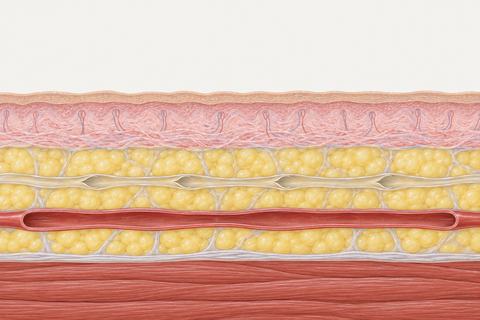
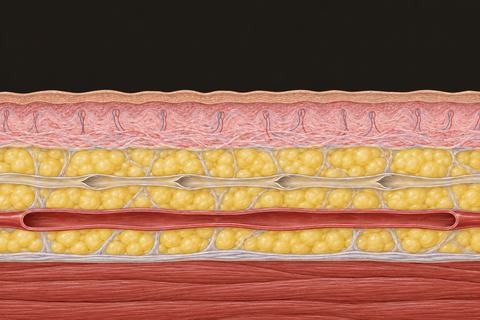

Your device asks for less motion, so this animation does not play. The picture shows the end result and the list explains every step.
-
Germs can sit on skin and on the rubber top of a vial. You cannot see them.
Evidence: In humans
-
The needle goes through the skin. It can carry germs into the fat layer underneath.
Evidence: In humans
-
Germs grow under the skin. They may form a pocket of pus (abscess), or redness spreads (cellulitis).
Evidence: In humans
-
Germs can travel along a lymph vessel. Red lines on the skin can be a sign of this.
Evidence: In humans
-
Germs in the blood can cause sepsis. Spreading redness, red lines, fever, feeling very ill? Get help now.
Evidence: In humans
In short: A needle can carry germs from the skin, the rubber top of a vial or the liquid into the fat under the skin. There they can form an abscess or cause cellulitis, spread along lymph vessels and reach the blood (sepsis). Spreading redness, red lines, fever or feeling very ill need a doctor straight away. With confusion, very fast breathing or blotchy skin, call your local emergency number.
Lines: solid = shown in people
Based on: World Health Organization (2010)10; Preventing Unsafe Injection Practices21; Safe Injection Practices to Prevent Transmission of Infections to Patients22; Smith et al. (2013)23; Skin abscess9; Cellulitis8; Lymphangitis17; Sepsis18
AI-generated illustration (gpt-image-2.5-sunburst-2026-09-08, 21 October 2026) CC BY 4.0 Image details The picture contains no text; the words, lines and moving marks on it are added by this site.
In detail: How common a normal reaction is , about 1 minute to read
-
Redness, itching, pain, irritation or bruising at the spot
25 in 100 Tesamorelin
14 in 100 Placebo (dummy injection)
Each square is one person in 100. Source EGRIFTA SV (tesamorelin for injection)2 Evidence Human trials
A small reaction where the needle went in is common, also with authorised medicines. Tesamorelin is an authorised peptide medicine. In its trials, 25 in 100 people had a reaction at the spot in the first 26 weeks. This means redness, itching, pain, irritation or bruising. With a dummy injection (placebo) it was 14 in 100.2
In detail: Abscesses without germs , about 1 minute to read
Not every abscess contains germs. After vaccinations, abscesses usually come from germs that got in. Less often they are sterile: a reaction to an ingredient of the liquid itself. One report describes two children who had this after vaccines that contained aluminium.24 From the outside, both are a painful lump. So let a doctor check any lump that grows, hurts or does not go away.9
Allergic reactions
What if I react badly to it?
- A mild reaction is an itchy, raised rash, or puffy eyes or lips, with normal breathing. Stop using the product and contact your GP. Do not use it again until a doctor has looked at it.25
- A severe reaction (anaphylaxis) makes the throat or tongue swell, makes breathing hard or wheezy, or makes you feel faint. It usually starts within minutes. Call your local emergency number. If you have an adrenaline pen, use it.26,25
Dutch harm-reduction advice for people who inject is not to inject alone, so that someone can help or call for help.11 The same idea makes sense the first time you use any new product.
In detail: Why the body can react to a peptide , about 1 minute to read
The body can react against the peptide itself. Antibodies and allergic reactions have been described for some peptide medicines.27 In tesamorelin trials, allergic reactions such as rash and hives were reported. The label tells people to get medical help at once if they suspect one.2 Clumped peptide may also make an immune reaction more likely.28
Stop-now warning signs
Call your local emergency number now
- Pain at the injection spot that is much worse than it looks, or dark, purple or grey patches or blisters there This can be a rare, fast-spreading infection of the deep layers under the skin (necrotising fasciitis).
- Swelling of the lips, tongue or throat, trouble breathing or swallowing, wheezing, a hoarse voice, or feeling faint, soon after an injection This can be a severe allergic reaction (anaphylaxis), which is life-threatening and gets worse very quickly.
Get medical help today
- Redness, heat, swelling or pain around the injection spot that keeps growing or getting worse This can be a skin infection (cellulitis), which needs antibiotics before it spreads.
- Red lines that run from the injection spot towards the armpit or groin The infection may be spreading along the lymph vessels, and from there into the blood. If you also have a fever with a fast heartbeat or fast breathing, call your local emergency number.
- A painful, warm lump that fills with pus This is probably an abscess: it often needs draining by a doctor, so do not squeeze it.
- You were pricked by a needle that someone else had used Blood on a used needle can pass on HIV and hepatitis B or C, and preventive treatment works best within hours.
Stop and contact a doctor
- A lump at an injection spot that does not go away, or keeps growing A doctor should check whether it is an abscess, a reaction to the product or something else.
- An itchy, raised rash, or puffy eyes or lips, while breathing stays normal Your body may be reacting to the product, and using it again can bring the reaction back.
Sources
Every claim on this page links to one of these sources. Scholarly sources link to their DOI; regulatory sources to the regulator's own page.
In detail: All 28 sources, numbered as in the text , about 4 minutes to read
- (2026). Wegovy (semaglutide): EPAR — overview and product information. Official product information ema.europa.eu (opens an external site) — accessed 20 October 2026 ↩
- (2026). EGRIFTA SV (tesamorelin for injection): prescribing information and instructions for use. Official product information dailymed.nlm.nih.gov (opens an external site) — accessed 20 October 2026 ↩
- (2026). Ik ga insuline spuiten bij diabetes type 2. Web page thuisarts.nl (opens an external site) — accessed 20 October 2026 ↩
- (2023). Veilig injecteren van anabole steroïden. Web page mainline.nl (opens an external site) — accessed 20 October 2026 ↩
- (2013). Prevalence and risk factors of lipohypertrophy in insulin-injecting patients with diabetes. Diabetes & Metabolism 39:445-453. Research article doi:10.1016/j.diabet.2013.05.006 (opens an external site) ↩
- (2026). OZEMPIC (semaglutide) injection — prescribing information (revised 05/2026). Official product information accessdata.fda.gov (opens an external site) — accessed 20 October 2026 ↩
- (2016). New Insulin Delivery Recommendations. Mayo Clinic Proceedings 91:1231-1255. Guideline doi:10.1016/j.mayocp.2016.06.010 (opens an external site) ↩
- (2024). Cellulitis. Web page nhs.uk (opens an external site) — accessed 20 October 2026 ↩
- (2026). Skin abscess. Web page nhs.uk (opens an external site) — accessed 20 October 2026 ↩
- (2010). WHO best practices for injections and related procedures toolkit (WHO/EHT/10.02). World Health Organization, Geneva. Report who.int (opens an external site) — accessed 20 October 2026 ↩
- (2026). Injecteren (spuiten/slammen): risico's verminderen. Web page drugsinfo.nl (opens an external site) — accessed 20 October 2026 ↩
- (2021). DOs and DON'Ts of Proper Sharps Disposal. Regulator fda.gov (opens an external site) — accessed 20 October 2026 ↩
- (2021). What to Do if You Can't Find a Sharps Disposal Container. Regulator fda.gov (opens an external site) — accessed 20 October 2026 ↩
- (2023). Best Way to Get Rid of Used Needles and Other Sharps. Regulator fda.gov (opens an external site) — accessed 20 October 2026 ↩
- (2026). Ik heb wondroos. Web page thuisarts.nl (opens an external site) — accessed 20 October 2026 ↩
- (2023). Boils. Web page nhs.uk (opens an external site) — accessed 20 October 2026 ↩
- (2025). Lymphangitis. Web page medlineplus.gov (opens an external site) — accessed 20 October 2026 ↩
- (2026). Sepsis. Web page nhs.uk (opens an external site) — accessed 20 October 2026 ↩
- (2022). Ik heb een sepsis. Web page thuisarts.nl (opens an external site) — accessed 20 October 2026 ↩
- (2026). Necrotising fasciitis. Web page nhs.uk (opens an external site) — accessed 20 October 2026 ↩
- (2024). Preventing Unsafe Injection Practices. Regulator cdc.gov (opens an external site) — accessed 20 October 2026 ↩
- (2024). Safe Injection Practices to Prevent Transmission of Infections to Patients. Regulator cdc.gov (opens an external site) — accessed 20 October 2026 ↩
- (2013). Fungal infections associated with contaminated methylprednisolone injections. The New England Journal of Medicine 369:1598-1609. Research article doi:10.1056/NEJMoa1213978 (opens an external site) ↩
- (2009). Recurrent sterile abscesses following aluminium adjuvant-containing vaccines. BMJ Case Reports 2009. Research article doi:10.1136/bcr.09.2008.0951 (opens an external site) ↩
- (2025). Ik krijg ineens dikke ogen of lippen. Web page thuisarts.nl (opens an external site) — accessed 20 October 2026 ↩
- (2023). Anaphylaxis. Web page nhs.uk (opens an external site) — accessed 20 October 2026 ↩
- (2013). Pharmacokinetics and pharmacokinetic-pharmacodynamic correlations of therapeutic peptides. Clinical Pharmacokinetics 52:855-868. Review doi:10.1007/s40262-013-0079-0 (opens an external site) ↩
- (2006). Effects of protein aggregates: an immunologic perspective. The AAPS Journal 8:E501-E507. Review doi:10.1208/aapsj080359 (opens an external site) ↩