Sharps disposal: getting rid of used needles safely
In short
About 5 minutes for the short version; 7 with every detail open.
- Put every used needle straight into a hard sharps container. Never into a bin or the recycling.
- In the Netherlands, ask your pharmacy for a needle box.
- When it is full, ask your pharmacy to take it back, or use your town's chemical waste point.
- Pricked by someone else's needle? Let it bleed, wash it, and call a doctor now.
- Preventive HIV treatment only works if you start quickly, and not after 72 hours.

Each section starts with the short answer. The rest is folded under “In detail”.
“Sharps” are needles and anything else that can cut or prick the skin. A used needle can carry blood. Blood can carry HIV, hepatitis B and hepatitis C, even when you cannot see it.1
Your own used needle is mostly a danger to other people. A loose needle in a bin or a bag can prick a child, a partner, a cleaner or a waste worker.2,3 Safe disposal takes a few seconds. It protects everyone around you.
Never in a bin, the recycling or the toilet
Can I put a used needle in the bin?
Medicines and their leftovers also do not belong in household waste, the sink or the toilet.5,6
In the Netherlands
Where do I get a needle container, and where does it go when full?
Get a needle container
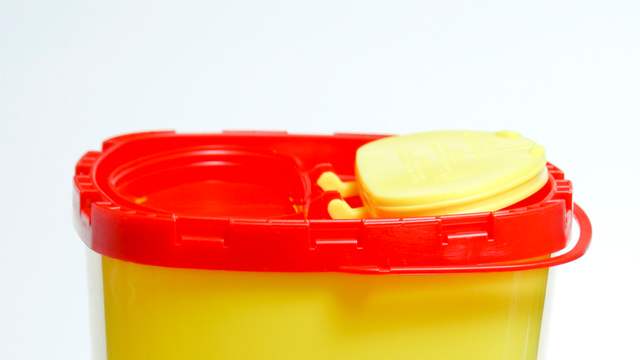
In the Netherlands, used needles always go into a needle container (naaldencontainer). You can get one at your pharmacy (apotheek).5
In detail: What a needle container is, and what to use until you have one , about 1 minute to read
It is a box of hard plastic that needles cannot easily pierce, with a lid that closes tightly.7,8
No container yet? Then use a strong, hard plastic or metal container with a tight lid for now, such as an empty detergent bottle. Write “used needles” on it. Swap it for a proper container as soon as you can.2,7
Use it safely
- Keep the container within reach every time you inject.
- Put the needle and syringe in straight after use. Do not put the cap back on first.
- Do not push the contents down to make room. Do not try to take anything out.
- Close it for good when it is three-quarters full, or at the fill line.
- Keep it upright, closed and out of reach of children and pets.
Return it when it is full
- Your pharmacy. You can usually return a full needle container to your pharmacy. Ask yours first.10,5
- Your municipality’s collection point for small chemical waste (klein chemisch afval, kca). This can be a recycling centre (milieustraat or milieuplein), a collection van (chemokar) or a depot. Each municipality decides how it collects, so check your municipality’s website or call them.11,5
- Other places. Used needles can also be handed in at some hospitals, GGDs and addiction services.2
In detail: Why a full container counts as medicine waste , about 1 minute to read
Dutch pharmacists count used needles in a container as medicine waste. Medicine waste goes back to the pharmacy or to a chemical waste point, not into the household waste.5
After a needle-stick injury
What if I am pricked by a needle someone else used?
A needle-stick injury is a prick from a needle that someone has already used. The risk depends on whose needle it was and whether there was blood on it.12,1
-
Start of treatment (RIVM)
ideally within 1 hour
no later than 72 hours
-
PEP against HIV (Thuisarts)
preferably within 2 hours
still possible up to 72 hours; after that it no longer works
Sources Hygiënerichtlijn voor piercen; Ik heb onveilige seks gehad met iemand die hiv of misschien hiv heeft; World Health Organization (2010)8,12,1
If only you used the needle, you cannot catch a virus from your own blood. Clean the wound and watch for signs of infection, such as spreading redness or pus.13 See the warning signs.
In detail: What the doctor will do , about 1 minute to read
The doctor first asks questions. Whose needle was it? Was there blood on it? When did it happen? Are you vaccinated against hepatitis B? Then the doctor decides what you need.12,1
- HIV: you may get PEP. PEP is a month of daily pills that makes an HIV infection much less likely. It works only if you start very quickly, preferably within 2 hours. After 72 hours it no longer works. Most GGDs can be reached 24 hours a day for PEP. When the GGD is closed, call a hospital emergency department.12,1
- Hepatitis B: if you are not vaccinated, you may get a vaccine and sometimes antibodies, as soon as possible. If you were vaccinated before, you probably do not need this.12,1
- Hepatitis C: there is no preventive treatment. Instead, you get blood tests in the following weeks and months, so that an infection can be found and treated early.1
If the person whose needle it was is known, they can be asked to get a quick HIV test. This helps the doctor decide whether you need PEP.12
Other countries
What if I live outside the Netherlands?
| Germany | Belgium | United Kingdom | United States | |
|---|---|---|---|---|
| Official advice on household needles found? | No No federal guidance found; only on medicines14 | No None found on our list of trusted sources | Yes GOV.UK: some councils collect clinical waste from homes15 | Yes The FDA’s two steps9 |
| A service that takes full containers? | Unknown Ask your pharmacy or your local waste advice service (Abfallberatung) | Unknown Ask your pharmacist or your municipality | Yes In England and Wales, some councils; there may be a charge15 | Yes Drop-off sites, mail-back programmes and pick-up services9 |
The rules for household sharps differ between countries, and often between towns. Your pharmacist can usually tell you what to do locally.
In detail: Germany, Belgium, the United Kingdom and the United States in detail , about 2 minutes to read
Germany
How medicines are disposed of differs by region in Germany. In most regions they go into the residual waste (Restmüll); in others, to mobile collection or recycling centres.14 We found no federal guidance on household needles. Use a closed, puncture-proof container and ask your pharmacy or your local waste advice service (Abfallberatung).
Belgium
We found no official Belgian guidance for households on our list of trusted sources. Use a closed, puncture-proof container and ask your pharmacist or your municipality.
United Kingdom
In England and Wales, some councils collect used syringes and other clinical waste from homes. There may be a charge. You can find your council’s service on GOV.UK.15 Ask your GP or pharmacist about a sharps bin.
United States
The FDA advises two steps. First, put needles in a sharps container straight after use. Second, when it is three-quarters full, follow your local rules. Options include drop-off sites such as pharmacies, hospitals and health departments, household hazardous waste sites, mail-back programmes and special pick-up services.9 If you have no approved container, a heavy-duty plastic household container with a tight, puncture-resistant lid can be used.7
Sources
Every claim on this page links to one of these sources. Scholarly sources link to their DOI; regulatory sources to the regulator's own page.
In detail: All 15 sources, numbered as in the text , about 2 minutes to read
- (2010). WHO best practices for injections and related procedures toolkit (WHO/EHT/10.02). World Health Organization, Geneva. Report who.int (opens an external site) — accessed 20 October 2026 ↩
- (2026). Injecteren (spuiten/slammen): risico's verminderen. Web page drugsinfo.nl (opens an external site) — accessed 20 October 2026 ↩
- (2016). New Insulin Delivery Recommendations. Mayo Clinic Proceedings 91:1231-1255. Guideline doi:10.1016/j.mayocp.2016.06.010 (opens an external site) ↩
- (2021). DOs and DON'Ts of Proper Sharps Disposal. Regulator fda.gov (opens an external site) — accessed 20 October 2026 ↩
- (2025). Medicijnafval: niet weggooien, maar inleveren. Web page apotheek.nl (opens an external site) — accessed 20 October 2026 ↩
- (2026). Wegovy (semaglutide): EPAR — overview and product information. Official product information ema.europa.eu (opens an external site) — accessed 20 October 2026 ↩
- (2021). Sharps Disposal Containers. Regulator fda.gov (opens an external site) — accessed 20 October 2026 ↩
- (2026). Hygiënerichtlijn voor piercen. Regulator rivm.nl (opens an external site) — accessed 20 October 2026 ↩
- (2023). Best Way to Get Rid of Used Needles and Other Sharps. Regulator fda.gov (opens an external site) — accessed 20 October 2026 ↩
- (2025). Nadroparine. Web page apotheek.nl (opens an external site) — accessed 20 October 2026 ↩
- (2026). Waar kan ik klein chemisch afval (kca) inleveren?. Regulator rijksoverheid.nl (opens an external site) — accessed 20 October 2026 ↩
- (2022). Ik heb onveilige seks gehad met iemand die hiv of misschien hiv heeft. Web page thuisarts.nl (opens an external site) — accessed 20 October 2026 ↩
- (2024). Cellulitis. Web page nhs.uk (opens an external site) — accessed 20 October 2026 ↩
- (2026). Umgang mit Arzneimitteln: Richtig lagern, einnehmen und entsorgen. Regulator gesund.bund.de (opens an external site) — accessed 20 October 2026 ↩
- (2026). Request clinical waste collection. Regulator gov.uk (opens an external site) — accessed 20 October 2026 ↩