How signalling works: receptors, messages and side effects
In short
About 6 minutes for the short version; 12 with every detail open.
- Most peptide medicines work from outside the cell. They fit a receptor, like a key in a lock.
- The receptor passes the message inside the cell. On its way in, the signal grows stronger.
- One receptor sits in many organs. So one medicine has many effects, good and bad.
- A precise key can still harm you: in the wrong organ, in large amounts, or over time.
- The body pushes back. Cells turn down receptors, and hormone systems brake themselves.
Each section starts with the short answer. The rest is folded under “In detail”.
A peptide medicine does nothing by itself. It works by passing a message to a cell, and the cell does the rest. This page explains how that message travels, and why a precise message can still have unwanted effects.
Receptors: locks on the cell surface
How does a peptide tell a cell what to do?
- The key arrives. A hormone or peptide medicine reaches the cell through the blood.
- It fits the lock. It binds a receptor that sits in the cell’s outer wall and reaches through to the inside.
- The receptor changes shape. On the inside it switches on a helper protein, a G protein.
- A second messenger is made. The G protein switches on an enzyme that makes many molecules of a small messenger, cAMP.
- The signal spreads. cAMP switches on enzymes (kinases) that change many other proteins. The cell responds, for example by releasing insulin.
- The signal stops. The receptor is switched off or pulled inside the cell, so the message does not run forever.
Peptides are large and water-loving, so most cannot pass through the oily outer wall of a cell.4 They act on receptors at the surface instead. Many peptide hormones use this family of receptors, called G-protein-coupled receptors (GPCRs).5
In detail: Receptor families, and why a small signal has a big effect , about 2 minutes to read
A large family of drug targets
GPCRs are the most studied drug targets: one analysis counted 475 drugs, about 34% of all drugs approved in the United States, that act at 108 different GPCRs.6 Many of the body’s own peptides act on them, and nearly 50 approved peptide medicines target them, most of them copies or modified versions of a natural peptide.5 G proteins are used by virtually all cells in the body.7
Not every hormone passes its message on through cAMP. Growth hormone, for example, acts on its own receptor and signals inside the cell through a different route, the STAT 5b pathway.8
The GLP-1 receptor as a worked example
When GLP-1 or a medicine such as semaglutide binds the GLP-1 receptor, the receptor switches on an enzyme (adenylate cyclase) and cAMP rises. In the insulin-making beta cells of the pancreas, cAMP acts through two proteins, PKA and Epac2, to increase insulin release.1 This chain has been worked out mainly in cell lines and animal islets (Evidence level: Shown in cells or tissue in the laboratory).1
Amplification
cAMP is one of the main second messengers that GPCRs use. A small signal at the cell surface is multiplied on its way inward: the kinase that cAMP switches on amplifies the signal again, and the effect reaching the cell’s nucleus is larger still.2 That is why tiny amounts of a hormone can have large effects, and why a receptor does not need to be fully occupied to give a full response.9
Grip and push: affinity and efficacy
Does binding to a receptor mean switching it on?
| Full agonist | Partial agonist | Antagonist | |
|---|---|---|---|
| Binds the receptor? | Yes Yes9 | Yes Yes9 | Yes Yes9 |
| Switches it fully on? | Yes Gives the largest response the cell can make10 | No Only part of the way, even when every receptor is taken10 | No Does not switch it on at all10 |
| Can it weaken the body’s own signal? | No Not directly: it adds its own push9 | Yes It takes receptors away from a stronger signal9 | Yes It blocks the receptor9 |
Affinity is how tightly a molecule grips its receptor. Efficacy is how strongly it switches the receptor on once bound.9,10 Most peptide medicines that act on GPCRs are agonists made by changing a natural peptide.5 Orforglipron, a small-molecule GLP-1 medicine, is a partial agonist.11,12
In detail: Affinity, efficacy and potency in more detail , about 2 minutes to read
- Affinity is a fixed property of each drug–receptor pair. It is often expressed as the concentration needed to occupy half of the receptors.9
- Efficacy cannot be measured directly. It is inferred from the response, which also depends on how many receptors a cell has and how well the cell turns an active receptor into a response.9
- Potency is the amount of drug needed for a given effect. It reflects both affinity and efficacy.10
- Inverse agonists turn down a receptor that is active on its own, the opposite of an agonist.10,9
- Biased agonists switch on some of a receptor’s signals more than others. A single drug can act as an agonist for one signal and an antagonist for another at the same receptor.9 In its developers’ laboratory tests, orforglipron favoured the G-protein signal of the GLP-1 receptor over a second route (the recruitment of beta-arrestins) (Evidence level: Shown in cells or tissue in the laboratory).11
Grip is not everything. In cell tests, semaglutide bound the GLP-1 receptor about three times less tightly than liraglutide, its predecessor. Its designers accepted that in exchange for tighter binding to albumin in the blood, which makes it last about a week.13,14 How long a molecule stays at its target matters as much as how hard it grips; see pharmacokinetics.
One molecule, many effects
Why does one medicine have so many effects?
The short animation shows where one peptide medicine, semaglutide, acts in the body, one step at a time.
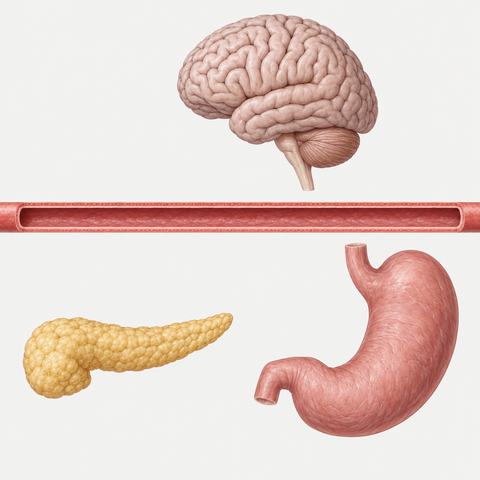
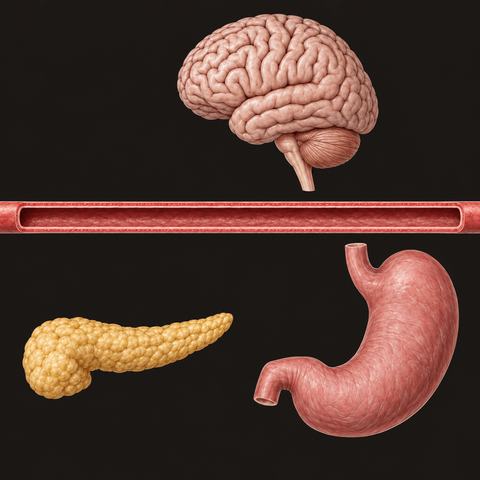

Your device asks for less motion, so this animation does not play. The picture shows the end result and the list explains every step.
-
Semaglutide travels in the blood, stuck to a protein called albumin. This keeps it working for days.
Evidence: In humans
-
In the pancreas, it switches on beta cells. They release more insulin, mainly when blood sugar is high.
Evidence: In humans
-
It also lowers glucagon, a hormone that raises blood sugar. This also happens mainly when sugar is high.
Evidence: In humans
-
After a meal, food may leave the stomach a bit more slowly. This small effect seems to fade.
Evidence: In humans
-
In animals, it reaches brain areas that control hunger. In people, trials show less hunger and smaller meals.
Evidence: In animals In humans
In short: Semaglutide lowers blood sugar when it is high and helps people eat less. These effects were measured in people. The stomach effect is small and seems to fade with time. Which brain areas take part comes mainly from animal studies.
Lines: solid = shown in people long dashes = shown in animals
Based on: Ozempic (semaglutide)15; Wegovy (semaglutide)14; Kapitza et al. (2017)16; Gabery et al. (2020)17; Friedrichsen et al. (2021)18
AI-generated illustration (gpt-image-2.5-sunburst-2026-09-08, 20 October 2026) CC BY 4.0 Image details The picture contains no text; the words, lines and moving marks on it are added by this site.
GLP-1 receptors are found on insulin-making cells in the pancreas, in the brain and nerves, in the heart and blood vessels, the kidneys, the lungs and the lining of the gut.19 A medicine cannot choose which of them it reaches. The wanted effect in one organ and the side effect in another often come from the very same receptor.
In detail: The same receptor, wanted and unwanted effects , about 1 minute to read
| Where the GLP-1 receptor is | What happens there | Wanted or not? |
|---|---|---|
| Pancreas | More insulin when blood sugar is high, less glucagon | Wanted in type 2 diabetes |
| Brain | Less hunger, more fullness | Wanted for weight management |
| Stomach and gut | Food leaves the stomach more slowly | Mixed. Stomach and gut problems, such as feeling sick, are the most common side effects |
| Thyroid C-cells of rats and mice | Over time, tumours in two-year rodent studies | Unwanted; relevance for people considered low but not excluded |
In the main placebo-controlled Wegovy weight trials (STEP 1 to 4, 68 weeks), nausea was reported by 43.9% of people on semaglutide against 16.1% on placebo.14 The thyroid finding shows a second point: receptors differ between species. Rat and mouse thyroid C-cells carry GLP-1 receptors, while human and monkey C-cells had low levels (Evidence level: Shown in animal studies), which is one reason a result in rodents may not carry over to people.20 More on this on the translation gap.
Precise is not the same as harmless
If a peptide is very specific, can it still cause harm?
Occasional use: dark skin patches were rare
1 in 100
developed dark patches of skin in the main trials
Who took part Bremelanotide (Vyleesi), US label: phase 3 placebo-controlled trials in 1,247 premenopausal women, used at most eight times a month Source VYLEESI (bremelanotide injection)21 Evidence Human trials
Daily use: dark patches were common
38 in 100
developed dark patches after eight days of daily use
Who took part Bremelanotide (Vyleesi), US label: a separate study with daily use for eight days Source VYLEESI (bremelanotide injection)21 Evidence Humans, limited
Bremelanotide, an authorised US medicine, switches on several related receptors. One of them, MC1R, sits on pigment cells, so more exposure meant more dark patches.21 Selectivity is never absolute: it falls as the concentration of a drug rises.10
In detail: Four ways a precise key causes trouble , about 2 minutes to read
1. The right receptor in the wrong tissue
The receptor a medicine is aimed at often also sits elsewhere. GLP-1 medicines slow the stomach because the stomach responds to GLP-1 too (see the table above).1,14
2. Other receptors
Few molecules fit only one receptor. The US label states that bremelanotide “nonselectively activates several receptor subtypes” of the melanocortin family, with MC1R and MC4R the most relevant. MC1R sits on pigment cells (melanocytes), where switching it on increases pigment. Dark patches appeared on the face, gums and breasts. The label warns that they may not clear completely after stopping.21
3. More drug, less selectivity
A drug’s preference for one target over another depends on concentration. Pharmacology teaching states it plainly: the higher the dose, the lower the selectivity and the greater the chance of harm.10 This is one reason the dose and the purity of a product matter so much, and why an unknown amount in a vial is a risk of its own (see product risk).
4. Growth signals are shared with tumours
Some peptides act on growth pathways: they push cells to divide, survive or grow new blood vessels. Cancers depend on the same capabilities: sustained growth signalling and the growth of new blood vessels are two of the recognised hallmarks of cancer.22 In a review of 21 observational (case-control) studies with 3,609 people with cancer and 7,137 without, higher blood levels of the growth factor IGF-1 went with modestly more prostate cancer and premenopausal breast cancer. Such studies show a link, not cause and effect.23 In the first of two randomised, placebo-controlled trials in healthy adults, with authors from the developer, a single injection of CJC-1295, an experimental peptide, raised IGF-1 for 9 to 11 days; the abstract does not give the number of participants.24 Whether unapproved peptides that push growth signals for months or years change cancer risk in people has not been studied (Evidence level: Proposed, not demonstrated in any experiment). Overstimulated receptors can, in principle, drive uncontrolled growth, which is one reason cells have brakes on them.3
The body pushes back
Does a peptide keep working the same way over time?
- The brain gives the order. The hypothalamus releases GHRH, a peptide, in pulses.
- The pituitary answers. It releases growth hormone in pulses.
- The body responds. Growth hormone raises IGF-1, a growth factor in the blood.
- The brake. Growth hormone and IGF-1 act back on the brain and pituitary. More somatostatin and less GHRH slow the next pulse.
- What a medicine changes. A peptide that pushes step 1 or step 2 raises the output, and the loop tries to adjust.
Two kinds of push-back matter. Cells turn down receptors that are stimulated without pause (desensitisation).3 And hormone systems use feedback loops that sense the result and slow the source.25 Both can make an effect fade, or even reverse.
In detail: Desensitisation and feedback, with medicines as examples , about 3 minutes to read
Desensitisation: from minutes to days
When a GPCR is stimulated again and again, the cell responds less. Within minutes, proteins called beta-arrestins stop the receptor from switching on its G protein. Over hours to days, receptors are pulled inside the cell and broken down, and the cell makes fewer new ones.3 Pharmacologists call a reduced response to repeated or prolonged exposure tolerance.10
Two examples from authorised medicines:
- A fading side effect. Semaglutide slows the stomach. Yet at the standard weight-management strength, the EU label reports no clinically relevant effect on how fast the stomach empties, “probably due to a tolerance effect”.14
- An effect that reverses. GnRH, a brain hormone, tells the pituitary to release LH and FSH, which keep the sex hormones going. In a study in rhesus monkeys whose own GnRH signal had been switched off, hourly pulses of GnRH restarted this system, while a constant infusion did not, and switching from pulses to a constant infusion could desensitise it again (Evidence level: Shown in animal studies).26 Leuprolide, a long-acting GnRH copy, shows the same in people: it at first raises LH, FSH and testosterone, and given continuously it lowers them, with testosterone falling to castrate levels within two to four weeks.27
Given without a break, it shut down the sex hormones
2–4 weeks
until the male sex hormone fell very low, after a first rise
Who took part People treated with continuous leuprolide (Lupron Depot), US label Source LUPRON DEPOT (leuprolide acetate for depot suspension)27 Evidence Established
Feedback: the body’s thermostat
Hormone systems are built like a thermostat. Growth hormone is released in pulses driven by GHRH and restrained by somatostatin. A burst of growth hormone feeds back on the brain within a short time, increasing somatostatin and reducing GHRH, and IGF-1 adds a slower brake.8 These negative feedback loops act at both the brain and the pituitary.25
The pattern matters as well as the amount: a review reports that separate pulses of growth hormone drive bone growth and switch on the IGF-1 gene in muscle more effectively than a steady level.8 So a peptide that changes the pattern can act differently from the body’s own pulses. For most unapproved peptides that act on the growth-hormone system, what long-term use does to these loops in people is unknown (Evidence level: Proposed, not demonstrated in any experiment). The two trials of CJC-1295 in healthy adults showed growth hormone and IGF-1 raised for days after an injection, but they lasted 28 and 49 days, not years.24
Sources
Every claim on this page links to one of these sources. Scholarly sources link to their DOI; regulatory sources to the regulator's own page.
In detail: All 27 sources, numbered as in the text , about 5 minutes to read
- (2019). Glucagon-like peptide 1 (GLP-1). Molecular Metabolism 30:72-130. Review doi:10.1016/j.molmet.2019.09.010 (opens an external site) ↩
- (2015). Genetically-encoded tools for cAMP probing and modulation in living systems. Frontiers in Pharmacology 6:196. Review doi:10.3389/fphar.2015.00196 (opens an external site) ↩
- (2018). GPCR desensitization: Acute and prolonged phases. Cellular Signalling 41:9-16. Review doi:10.1016/j.cellsig.2017.01.024 (opens an external site) ↩
- (2015). Strategic approaches to optimizing peptide ADME properties. The AAPS Journal 17:134-143. Review doi:10.1208/s12248-014-9687-3 (opens an external site) ↩
- (2020). Advances in therapeutic peptides targeting G protein-coupled receptors. Nature Reviews Drug Discovery 19:389-413. Review doi:10.1038/s41573-020-0062-z (opens an external site) ↩
- (2017). Trends in GPCR drug discovery: new agents, targets and indications. Nature Reviews Drug Discovery 16:829-842. Review doi:10.1038/nrd.2017.178 (opens an external site) ↩
- (2005). Mammalian G proteins and their cell type specific functions. Physiological Reviews 85:1159-1204. Review doi:10.1152/physrev.00003.2005 (opens an external site) ↩
- (2001). Neurophysiological regulation and target-tissue impact of the pulsatile mode of growth hormone secretion in the human. Growth Hormone & IGF Research 11 Suppl A:S25-S37. Review doi:10.1016/s1096-6374(01)80005-8 (opens an external site) ↩
- (2018). Making Sense of Pharmacology: Inverse Agonism and Functional Selectivity. International Journal of Neuropsychopharmacology 21:962-977. Review doi:10.1093/ijnp/pyy071 (opens an external site) ↩
- (2021). Defining and unpacking the core concepts of pharmacology education. Pharmacology Research & Perspectives 9:e00894. Research article doi:10.1002/prp2.894 (opens an external site) ↩
- (2020). Structural basis for GLP-1 receptor activation by LY3502970, an orally active nonpeptide agonist. Proceedings of the National Academy of Sciences of the United States of America 117:29959-29967. Research article doi:10.1073/pnas.2014879117 (opens an external site) ↩
- (2026). FDA Approves First New Molecular Entity Under National Priority Voucher Program. Regulator fda.gov (opens an external site) — accessed 22 October 2026 ↩
- (2015). Discovery of the once-weekly glucagon-like peptide-1 (GLP-1) analogue semaglutide. Journal of Medicinal Chemistry 58:7370-7380. Research article doi:10.1021/acs.jmedchem.5b00726 (opens an external site) ↩
- (2026). Wegovy (semaglutide): EPAR — overview and product information. Official product information ema.europa.eu (opens an external site) — accessed 20 October 2026 ↩
- (2026). Ozempic (semaglutide): EPAR — overview and product information. Official product information ema.europa.eu (opens an external site) — accessed 20 October 2026 ↩
- (2017). Effects of semaglutide on beta cell function and glycaemic control in participants with type 2 diabetes: a randomised, double-blind, placebo-controlled trial. Diabetologia 60:1390-1399. Clinical trial doi:10.1007/s00125-017-4289-0 (opens an external site) ↩
- (2020). Semaglutide lowers body weight in rodents via distributed neural pathways. JCI Insight 5:e133429. Research article doi:10.1172/jci.insight.133429 (opens an external site) ↩
- (2021). The effect of semaglutide 2.4 mg once weekly on energy intake, appetite, control of eating, and gastric emptying in adults with obesity. Diabetes, Obesity and Metabolism 23:754-762. Clinical trial doi:10.1111/dom.14280 (opens an external site) ↩
- (2022). Therapeutic peptides: current applications and future directions. Signal Transduction and Targeted Therapy 7:48. Review doi:10.1038/s41392-022-00904-4 (opens an external site) ↩
- (2010). Glucagon-like peptide-1 receptor agonists activate rodent thyroid C-cells causing calcitonin release and C-cell proliferation. Endocrinology 151:1473-1486. Research article doi:10.1210/en.2009-1272 (opens an external site) ↩
- (2025). VYLEESI (bremelanotide injection): prescribing information. Official product information dailymed.nlm.nih.gov (opens an external site) — accessed 20 October 2026 ↩
- (2011). Hallmarks of cancer: the next generation. Cell 144:646-674. Review doi:10.1016/j.cell.2011.02.013 (opens an external site) ↩
- (2004). Insulin-like growth factor (IGF)-I, IGF binding protein-3, and cancer risk: systematic review and meta-regression analysis. The Lancet 363:1346-1353. Meta-analysis doi:10.1016/S0140-6736(04)16044-3 (opens an external site) ↩
- (2006). Prolonged stimulation of growth hormone (GH) and insulin-like growth factor I secretion by CJC-1295, a long-acting analog of GH-releasing hormone, in healthy adults. The Journal of Clinical Endocrinology and Metabolism 91:799-805. Clinical trial doi:10.1210/jc.2005-1536 (opens an external site) ↩
- (2025). Negative Feedback Loops and Hormonal Factors that Regulate GH Secretion. Endocrinology 166:bqaf139. Review doi:10.1210/endocr/bqaf139 (opens an external site) ↩
- (1978). Hypophysial responses to continuous and intermittent delivery of hypopthalamic gonadotropin-releasing hormone. Science 202:631-633. Research article doi:10.1126/science.100883 (opens an external site) ↩
- (2026). LUPRON DEPOT (leuprolide acetate for depot suspension): prescribing information. DailyMed. Official product information dailymed.nlm.nih.gov (opens an external site) — accessed 22 October 2026 ↩